Meshtastic Off-Grid Mesh Network
Meshtastic is an open-source project that turns inexpensive LoRa radio hardware into an encrypted, off-grid mesh network. Nodes find each other automatically, relay messages across the mesh, and communicate without the internet, without cell towers, and without any central authority. Range between nodes is typically several kilometers in open terrain; a mesh of repeaters can cover a neighborhood or a city.
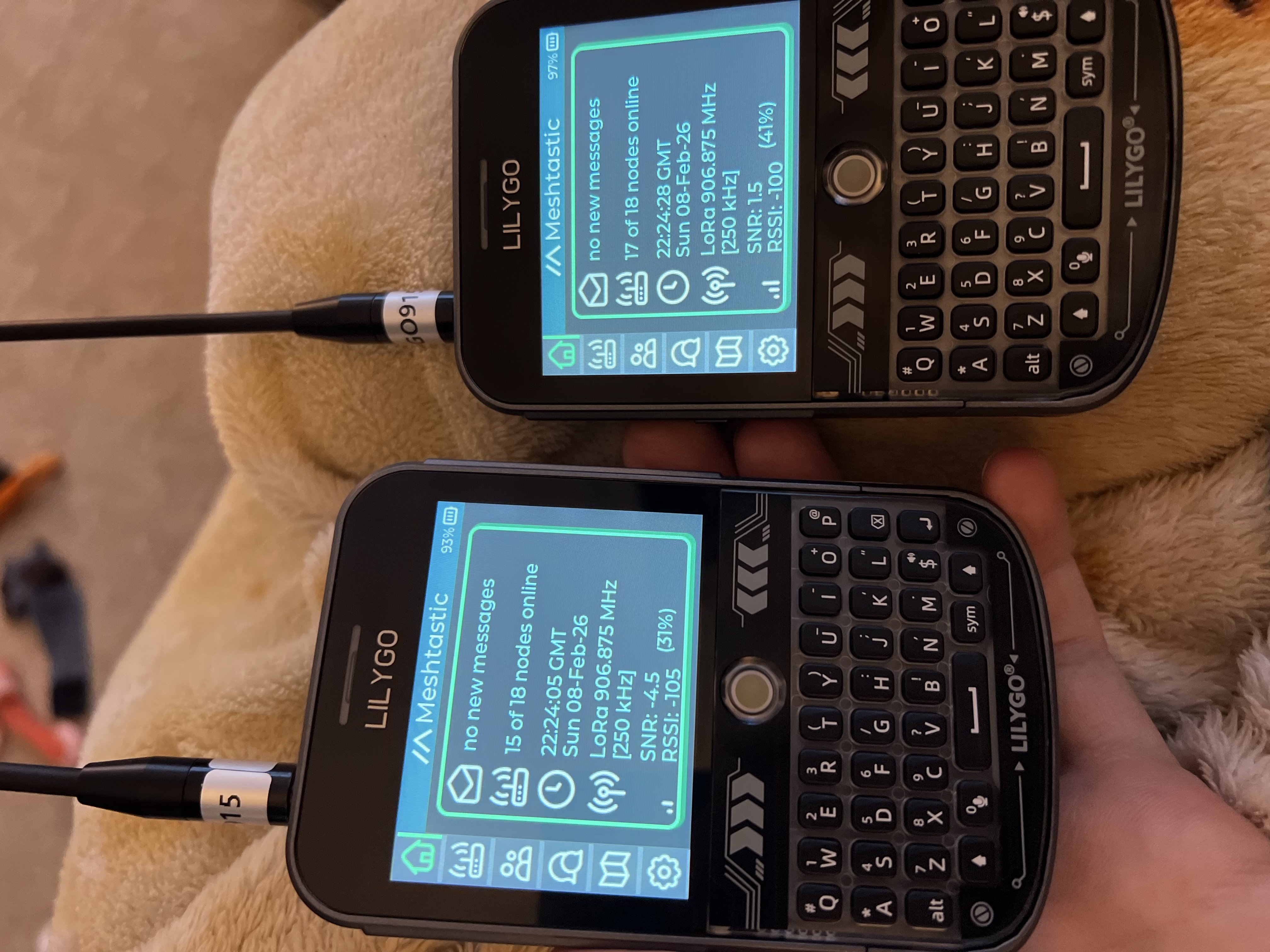
The appeal is not just technical. It's what the technology makes possible: communication infrastructure that is resilient, decentralized, and not subject to the decisions of any particular company or government. In an era where "the internet" and "the phone network" increasingly mean "Amazon's servers" and "AT&T's towers," a protocol you can run on a $40 device and a solar panel is worth understanding.
What's here now
Two device types are currently running or ready to deploy:
KEEPTEEN D5L Solar Repeater A dedicated mesh repeater built around RAKWireless RAK19007 and RAK4631 LoRa modules. Solar panel built in, 5000mAh battery, 915MHz antenna, weatherproof enough to mount outdoors. This is a fixed infrastructure node — a relay point that extends the range of the mesh without requiring a human to carry it. Set it somewhere with sun and line of sight, leave it alone.
LILYGO T-Deck Plus (×2) ESP32-S3 handheld devices with integrated 915MHz LoRa, GPS, a 2.8" display, keyboard, and external antenna. These function as the user-facing nodes — send and receive messages, see node locations on the map, navigate the mesh. Portable, battery-powered, and entirely self-contained.
Why this matters
While watching the situation in Minneapolis unfold — ICE incursions into the city, residents organizing mutual aid, early warning networks, neighborhood observation — I kept thinking about what happens to that kind of coordination when the infrastructure it runs on becomes unreliable, or when the companies running it decide to cooperate with the people you're organizing against.
Meshtastic doesn't solve every problem. But a mesh of local nodes, running open-source firmware, carrying encrypted messages between neighbors, with no telemetry, no accounts, and no servers to subpoena, is a meaningful piece of infrastructure for mutual aid and community resilience. It works when the internet doesn't. It works when someone has decided the internet shouldn't work for you.
What's next
The nodes are configured and running. The two T-Deck handhelds have been tested around the neighborhood and at various locations around Green Bay — range and reliability are solid. The solar repeater extends the mesh from a fixed point.
When I first powered up the nodes I expected to be starting from scratch — maybe one of a handful of people in the area with this equipment. Instead, there were already nodes all over much of the city. Green Bay has an active Meshtastic presence that was already growing before I joined it. That reframed the whole project: I wasn't building a network, I was strengthening one.
The next area of interest is building info bots — software that lives on a node and responds to queries from the mesh: weather conditions, status updates, local alerts. LoRa's bandwidth is narrow (this is not a video streaming protocol), but for short messages and structured data it's more than sufficient. It should also be structured as response only. Spamming messages at regular intervals is likely to upset the community.
The longer-term interest is in the mesh as infrastructure — not for my own use exclusively, but as something that could be useful to people nearby who might need it. That's a different kind of project than most things in this portfolio. It points outward.